
Summary
- Dry doesn’t automatically mean fried. Some roughness can occur after chemical processing.
- Gummy, mushy or excessively stretchy wet hair is more concerning, particularly alongside breakage.
- Your chemical history matters. Old bleach, colour, rebonding and perms still matter if those processed lengths remain on your head.
- Don’t immediately bleach a bad colour again. Correcting the shade and protecting compromised hair can be competing priorities.
- Treatments can improve damaged hair, but severely damaged lengths cannot simply become virgin hair again.
If you recently went to a salon for a chemical treatment and your hair feels worse than it did before, it is natural to wonder if the salon fried your hair.
Maybe it is no longer as soft, fluffy or supple. Perhaps it feels rougher after washing, tangles more easily or simply does not behave the way it used to.
Possibly, but dry or different-feeling hair does not automatically mean fried hair.
Significant breakage and strands snapping under gentle handling are much more concerning signs of chemical damage.
So before trying to “fix” the problem with another round of perm or rebonding, let’s first figure out how damaged your hair actually is and what it can safely handle next.
Fried Hair? You’re Not Alone in This
One of the reasons we decided to do this topic is because our hair salon noticed a trend of online discourse around salon breaching and having “maggi mee” hair.
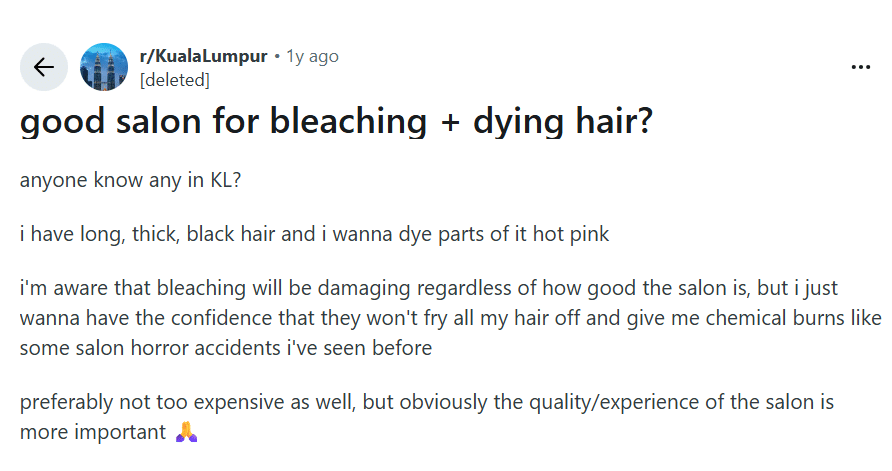
1. KL user worried about a salon frying their virgin hair
The poster has long, thick, black virgin hair and wants hot-pink sections. They already understand bleaching will cause some damage, but their concern is whether the salon will take it too far.
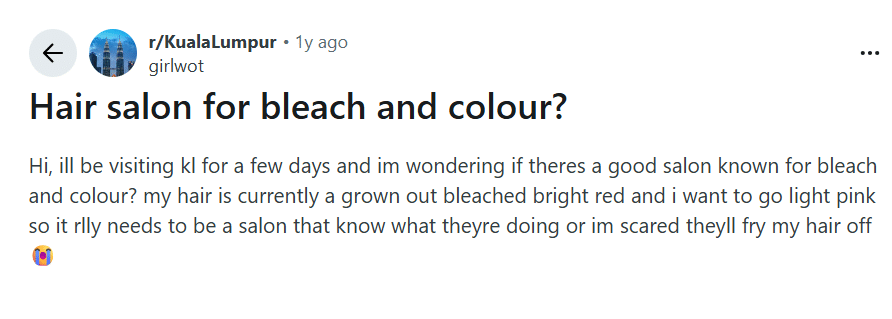
2. Another KL user with already-bleached red hair
This one is more targeted to chemically treated hair, rather than virgin hair.
The poster already has grown-out, bleached bright-red hair and wants to go light pink. Their concern is finding a salon experienced enough to deal with previously processed hair.
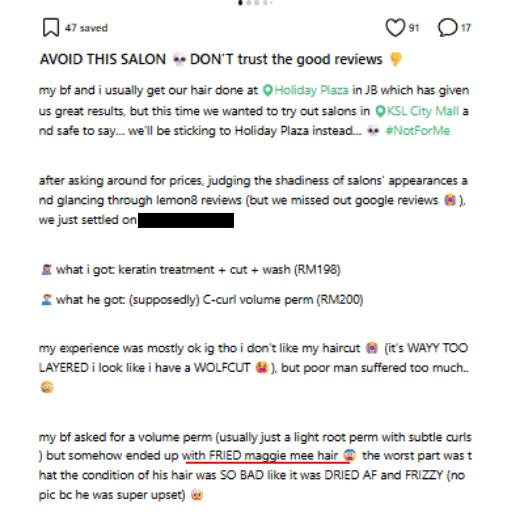
3. Bad Hair Salon Experiences
One Lemon8 user described getting a perm at a salon in KSL City Mall, Johor Bahru and leaving with what they called: “FRIED maggie mee hair”
They described their hair afterwards as: “DRIED AF and FRIZZY” and went to another salon to ask what could be done about the damage.
All of the complaints centered around a few key points too, we have noticed the following:
- Customers being assured their hair could handle a major transformation
- There is repeated rounds of bleach
- Burning sensations being dismissed (HUGE red flag)
- Hair looking fine immediately after styling but breaking afterwards
- They have to pay another salon to deal with the aftermath
So yeah, it’s chemical treated hair can be kinda scary and the horror stories from others can be long-lasting and scarring. But how do you identify fry hair?
How Do You Know If a Salon Has Fried Your Hair?
Pay attention to how your hair behaves, especially when wet.
Chemical services deliberately change hair. Some additional dryness after bleach, colour, perming or rebonding therefore isn’t really surprising, that’s normal!
What becomes more concerning is loss of strength and normal behaviour.
What you’re noticing | What it could indicate |
Slightly dry or rough | Typical chemical stress |
More tangling | Increased roughness/porosity |
Frayed ends | Fibre damage |
Increased snapping | Structural weakening |
Excessive stretching when wet | Significant compromise |
Gummy or mushy when wet | Severe chemical damage |
Breaking with gentle handling | Serious breakage |
If several of the symptoms above suddenly appeared after your appointment, don’t rush into another chemical service.
What Should You Do Immediately If Your Hair Feels Fried?
When a salon colour goes wrong, the instinct is understandably to fix it immediately.
Too orange? Bleach again.
Too dark? Strip it.
Bad texture? Straighten it.
Unfortunately, severely compromised hair doesn’t really care that you hate the colour.
For now:
- Pause aggressive chemical services, including further bleaching, rebonding and perming.
- Reduce high-temperature styling, particularly repeated straightening.
- Handle wet hair gently and don’t aggressively brush through knots.
- Use conditioning products that provide enough slip for gentle detangling.
- Have the condition assessed before another chemical procedure.
Sometimes preserving the hair you still have needs to outrank achieving the perfect shade this week.
Are There Any Treatments That Repair Fried Hair?
Unfortunately, there isn’t an all in one “fried hair treatment.” A stylist may recommend different approaches depending on your main problem, so let’s look at some scenarios.
Treatment | Most useful for | What it can realistically do |
Bond-building treatments | Bleached and chemically weakened hair | Help reinforce or improve properties of hair damaged during chemical processing |
Protein treatments | Weak, fragile hair that breaks easily | Temporarily improve strength and reinforce damaged areas of the hair fibre |
Deep conditioning treatments | Dry, rough, tangled hair | Improve softness, lubrication, flexibility and manageability |
Acidic / pH-balancing treatments | Porous, rough chemically treated hair | Help improve the feel and smoothness of the hair surface |
Leave-in conditioners and serums | Tangling, friction and rough ends | Add slip and reduce friction during brushing and styling |
Strategic trimming | Split, frayed or severely deteriorated ends | Physically removes damage that products cannot permanently restore |
Bond-building treatments
These are associated with bleached, coloured and chemically processed hair.
You’ll often hear terms such as bond repair, bond builder or bond strengthening. Different products use different technologies, so they don’t all work in exactly the same way.
Their purpose is to improve the strength or condition of chemically compromised hair.
Protein treatments
Hair is largely made from keratin protein, which is why protein-based treatments/ keratin treatments frequently appear in damaged-hair routines.
Hydrolysed proteins and amino-acid-containing formulations can help improve the feel and mechanical properties of some damaged hair.
Deep conditioning treatments
If your chemically treated hair primarily feels dry, rough, frizzy and impossible to detangle, conditioning is important.
A good conditioning treatment can improve:
- softness
- slip
- detangling
- flexibility
- surface smoothness
- manageability
Acidic or pH-balancing treatments
Chemically processed hair can become more porous and rough.
Acidic treatments are sometimes used after chemical services to help improve the condition and feel of the hair surface.
They aren’t an antidote to severe bleach damage, but for hair that feels rough, porous and difficult to manage after colouring, they may form part of a professional treatment plan.
Leave-in conditioners, oils and serums
Leave-ins and serums can provide slip, lubrication and reduced friction, making fragile hair easier to detangle and reducing unnecessary mechanical stress from brushing and styling.
And sometimes the treatment is… scissors
Nobody enjoys this answer but if your ends are badly split, transparent, constantly tangling or breaking away, there comes a point where another mask isn’t going to save those centimetres.
Just a slight trim, yeah, don’t need to cut the whole thing.
When Can You Chemically Treat Your Hair Again?
Hard to say, but for the sake of simplicity we’re going to make a simple traffic light system. As a rule, best stick to 8-10 weeks after your initial treatment.
🟢 Green
Hair is somewhat dry but remains relatively strong, manageable and behaves reasonably normally when wet.
Next step: Have a stylist assess whether further processing is appropriate.
🟠 Yellow
Hair tangles heavily, feels noticeably weaker, breaks more easily or has unusual wet elasticity.
Next step: Pause aggressive processing and reassess its condition.
🔴 Red
Hair becomes gummy or mushy, stretches dramatically, snaps under gentle handling or has already suffered significant breakage.
Next step: Another aggressive chemical service should not be your immediate solution.
Before Another Salon Touches Your Hair
If another salon has left your hair gummy, unusually stretchy, rough or prone to snapping, don’t make the next appointment another chemical gamble.
At REDS Hair Salon, tell us everything, yes everything.
The old bleach, the rebonding, the home colour. The highlights hidden underneath your current brown and of course, the chemical service you would rather forget.
We can assess the visible condition of your hair, discuss its chemical history and determine if another colour, bleach, perm or straightening service makes sense.
If you’re in or around Johor Bahru, you can visit REDS Hair Salon at any of our four branches:
Whichever branch you visit, bring your hair history with you. The more we know about what your hair has already been through, the better we can advise you on what it can realistically handle next.
Better yet, book a consultation with us and we know where to take you! o(* ̄▽ ̄*)ブ